Jemima Boncales designs visual images and is honored to serve as the main contact for Rubbishriot and Rubbishriot Productions.
Jemima Boncales is a self-made artist, raised in the American South. She draws inspiration from her study of music, philosophy, language, swordplay, cultures, traditions and global travel.
Letting go of something that I worked for, that is not the right fit for me is a slow and painful process. Each step of the way, I grudgingly resist and take my time. But why do I resist?
Today, I submitted my resignation to my current place of employment, where I worked as an NP. The challenge of childcare, emergency setting, incongruence with my values (no time for family, with high stress, not enough pay) pushed me in this direction.
I worked hard towards this particular direction, but received an overwhelming inner and outer current against it. The next current pushes me towards something uncertain and new, endless possibilities.
I like to speak in metaphors when I write sometimes, but it’s not helpful. So let me be more specific—the advantage of nursing is that I can choose a lot of different paths. I started looking at nurse coaching, writing, test writing, legal consulting, aesthetic, IV hydration. I even looked at working in Australia, and another friend suggested Jamaica as an NP. I have a lot of skills as an emergency NP, and I don’t want to lose it, but I also want to live the best possible life that honors the whole of me.
So how do I choose? I knock at different doors. Is this the right step? How do I choose and what is my process for choosing. Is my investment of time and energy going to be rewarded this time?
This feeling is the excitement of something new, coupled with the cloud of doubt casting a shadow on my sunshine of certainty.
I have a sketch of a plan. But some part of me whispers that I also dread change. But that’s untrue. I have faced multiple changes and challenges and uncertainties in the past. It’s the fear of perpetually facing my inner self, and my capacity to navigate my own darkness and doubts that slows me down.
We are here. In this space of creation in the a moment to create my own healing journey. What form and shape will it take or will I mold it into?
During one of my shifts in the ED, I sat beside an attending–black, woman–one of the very few black women in medicine that I have had a chance to encounter in my line of work. She exudes confidence and knowledge. She mentioned that she always wears her white coat despite the fact that it gets dirty very fast in a busy emergency department.
I listened to her talk to a scribe who was attempting go to med school about her experiences in medicine. She related that in her first job she was pushed out and targeted collectively and unfairly. In her second job, she had a repeat experience, so she learned how to defend herself, and was able to negotiate a better severance pay. Several jobs later, she finally found her niche or at least became well versed in navigating through the bias.
I was very interested in her experiences because I am a small woman of color (my last name sounds Latinx, but I am Asian), who also practice in the same line of work.
Joint Commission defines implicit bias as the attitudes or stereotypes that affect our actions voluntarily or involuntarily.
My experiences so far as an advance practitioner has been similar–patients, nurses, colleagues alike pose challenges and question my knowledge unfairly and excessively, whereas, a male/female caucasian colleague can accomplish similar tasks without road blocks, and find easy acceptance. The worse challenges come from other people of color who often prefer, and sometimes requests, the male caucasian provider, only to be told the similar instructions that I have given.
According to the the Association of American Medical Colleges, only 5% of all active physicians are Black vs 13% of the US population, and worse for Hispanic or Latinx 2.4% of active physicians are women, a total of 5.8% of doctors are Hispanic, when they are 18% of the overall US population (AAMC.org). It’s easy to assume that Healthcare is innovative, but actually it is slow to adapt to new ideas. It is reflective but oftentimes lack the stamina and will to change,– thus, many researchers and clinicians will say, “it takes 17 years to move evidence into practice”.
I talked to my father the other day, to discuss my experiences in healthcare, including the challenges of implicit bias. I wonder why do I try? He said, if God gave you the energy, the brains and the desire to change the landscape of healthcare, and move the needle against the status quo of systemic racism (overt or hidden), then you must. Emergency medicine is exhausting, I wonder where do I find the energy and desire to keep going?
If you are depressed you are living in past If you are anxious you are living in the future If you are at peace, you are living in the present. ~Lao Tzu
psychological health often manifests itself Physically.
In today’s meditation, I labeled the thoughts that flit through my head as past, present, or future. The majority of my thoughts are recent past, or near future. My current situation is the creation fueled by my emotions which are anchored in my thoughts.
My emotions have been driven largely by my definition of love. i’ve been yearning for love.
But, how can I feel love if my thoughts are not anchored in the present?
my mind often times yearns  for romantic love, not recognizing that this is a pattern and habit from my teenage years and the imprint of the culture of romance that’s seeps every movie, songs, books that I have read or chosen to read.
thoughts of recent past, mixed with near future are the types of thoughts that mask
the sensations of the present moment.
what is love, and how has it evolve in my current state and the framework of life?
Four years ago, this day, my mom’s spirit left her earthly body. Despite my scientific belief that energy can neither be created nor destroyed and my mother’s energy lives within me, in the very helix of my DNA, I couldn’t stop myself from grieving. My grief was a complicated by my imperfections, my guilt for not being present in mind and spirit sooner, for not accepting her change from that of healthy woman—my mom, my anchor—to woman who was anxious and in pain, whose body was ravaged by cancer, followed by hemorrhagic stroke. Her change in appearance and personality happened so fast, less than a year from when we received her diagnosis of stage 4 cancer. I couldn’t adjust and be objective. As a trained nurse, I should have been better prepared for her care and decline….
Many of us healthcare providers talk about death with dignity in terms of DNR or do not resuscitate. Many healthcare friends even jokingly talk about jumping off a cruise ship when the time comes or falling in a ravine in the Grand Canyon. They discuss this in half jest and seriousness with their family and loved ones. Death with dignity is almost equated with a DNR. But often without much details as to why this is so. My mom, also did not dwell in this type of discussion.
Many people only know of the life prolonging powers of medicine and do not understand why DNR is so important. They seek healthcare in hopes of avoiding the inevitable death. You see, we all like stories of miraculous cures, and the stories about patients whose family’s were not brave enough to say goodbye, to give the gift of death with dignity, are left untold. We like giving hope and holding on to hope. We don’t want to give the gory details of what happens to those patients who missed the window of opportunity for a sacred death. Death can happen under the precision of a scalpel, and if that doesn’t do it, the hands of healthcare can prolong the decay of the flesh with fluids, tube feeds and ventilators. We don’t talk about how those patients who missed their opportunities for a dignified death, smell like rotten flesh in the hospital’s hallway, from bed sores that gets to their very bone because no matter how often you turn a patient to prevent bed sores, when death is imminent, despite the prolonging artificial measures, flesh and life function decays. They don’t talk about how families stop to visit because no mind is left to interact with and how the bodies are left for the healthcare workers to tend to on a daily basis, sometimes for years.
That horrible description above is not the story of my mom. Her death is sacred and as beautiful as the life she led. On the day before she was hospitalized for the last time, she called everyone on her phone and told us to come see her because she was dying.
The following evening she was admitted and brought to the hospital floor that she worked on as a nurse for the past 20 years. And when she closed her eyes (from what I suspect was a subdural hematoma) the doctor spoke to us about what we wanted to do. Do we transfer her to larger hospital where maybe they would do surgery, intubate her, and she may or may not wake up, and if she miraculously wakes up, she is paralyzed, in pain from metastatic cancer? Or do we simply allow her a graceful passing?
She gave us ten days, ten days to say goodbye. During her 10 days of passing, her coworkers and friends gathered around and cooked us food for every meal, in honor of the countless of times she has cooked meals for others in the past. I sat by her side, sang and played ukelele with the five chords that I just learned. She spent a lot of energy to make me learn how to play the piano well. I played those five chords in a new instrument (that I could bring to the hospital bedside). I played with an understanding of music, feeling the rhythm of life from the strings of my heart. I played knowing this was the last time I get to play for her. My brothers and sister and father took turns sitting by her side. A couple of those evenings, we called and video chatted with her mom, her brothers, sisters, nephews and nieces across the world, to share our sorrow and the experience of her slow passing. Her graceful passing allowed us to reminisce about our childhood and experiences with her—that time when she baked banana bread using a tin can and some fire wood that smelled like poop (since we didn’t own an oven). The banana bread was still so good and so many people loved it. Or that time when dad left us to make a better life in the US and when he returned without any cash, she had way more money than he could ever imagine from selling Avon Products.
On the tenth night, we gathered around and sang songs and had the kids play with her warm but listless hands. I remember her shallow breaths and when I left her side, I suspected it was for the last time. As I drove home past midnight, I was tempted to turn right back around, but I also knew I couldn’t take it. So my father said, he woke up from sleep that night at her bedside because he dreamt that she said his name and he cried and left her side to ask the staff to help, and when he returned, she was gone.
Like I said, my grief was complicated. I had to travel to get away from the routine, the feelings. I needed to create new neurons of happiness and connections. When I returned, I immersed myself in the FNP program to help me direct my sadness in something useful, that honors her life and energy.
I sat by her gravesite the other day and let the years wash over me. I prayed that I would live a worthy life, that I would take the finality of death to make my actions matter, that I would not get lost in the momentary anxieties, but rather be open to create and be directed by the infinite energy that is beyond my own finite mind. I prayed that one day I would also have a sacred death, a death with dignity.
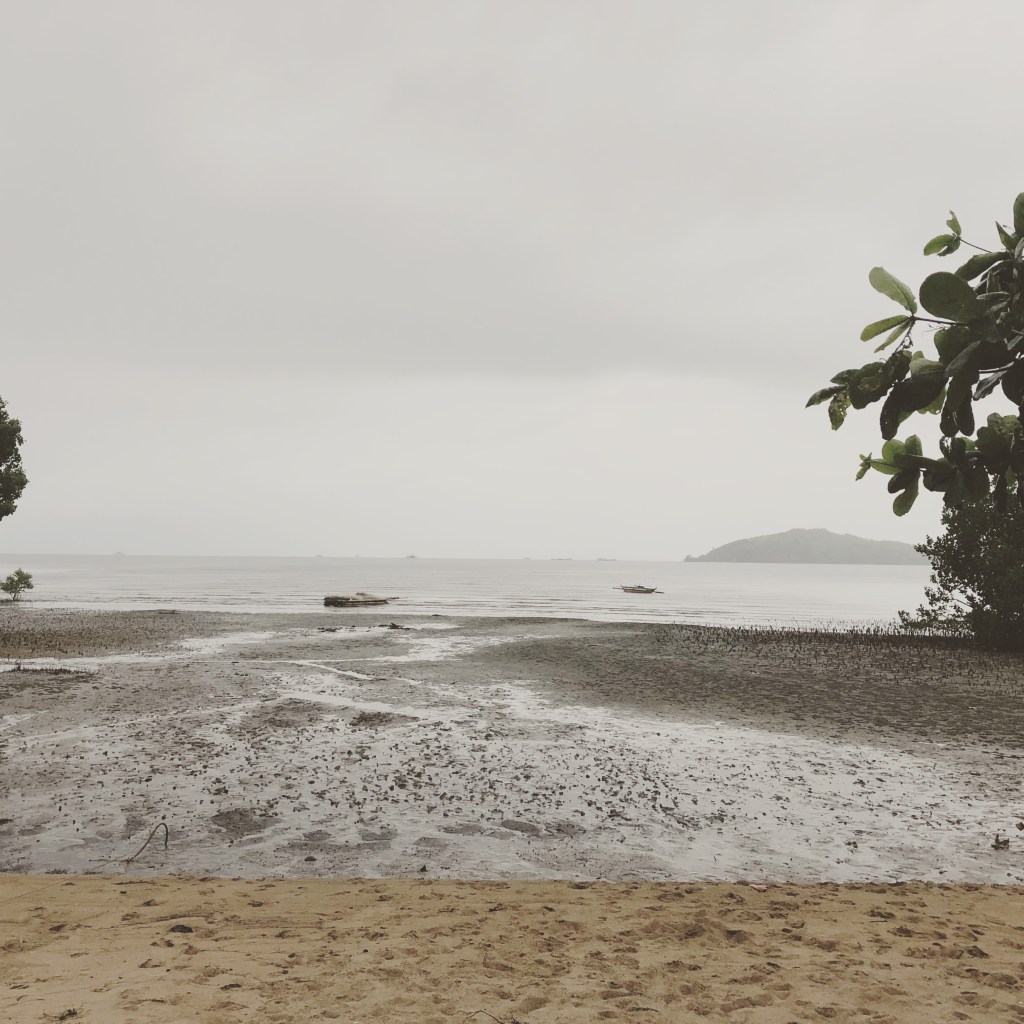
Photo taken behind my grandmother’s house, on my return home after mom’s passing
I’m first an artist, philosopher, then a parent, then a nurse (an Emergency nurse) and a nurse practitioner. This is my health blog and it’s inspired by the news front, by the events in the world, the little people that I am raising and my life experiences.
The past three years, the only things I’ve written are papers for a class. They are exercises in critical thinking for healthcare but they are not really written for general sharing. Every other line on those papers require citations (those little links that indicates that “this is not my original thought, this is the thought of other experts, who are more knowledgeable than me on this subject”). If I’m painting, my papers are like collages, tidbits and pieces of knowledge that I’m presenting together in this new way so my professor knows, yep, I got it (as often they’re the only audience to my writing.) When I was an artist, at the end of the year, I have a body of work that I can show and have other people say, “wow that’s cool! thanks for sharing!”. It was something tangible. As a healthcare professional, the closest thing to tangible is a shiny certificate after years of studying, sweat and tears.
As important as scholarly writing is, it’s a very heavy, weighty type of writing that can easily bore people. Time and time again, popularity in our social media has proven that we all like original thought. And that is the problem today—so many “original” thinkers in healthcare that becomes the loudest voices over and above reason. In philosophy class, we were always trying to breakdown the patterns of thought, to present another side of the argument—the whole “I think therefore I am” and even then, you ask the question of whether or not you’re only a simulacrum. But in healthcare, we build on the knowledge of other experts before us. Even those who get a pHD in heath related topic do not really explore the subject the way philosophers like Decartes and Baudrillard do. So, I am taking a much needed break from scholarly writing, to recapture my artist and philosopher self again and maybe come up with some original thinking… but then again, maybe not as original as drinking bleach or taking a horse pill.
 Reflections on Health and Well-being